Boldly going where many other writers have gone before
I’ve been trying to provide romance book recommendations and romcom stories with this newsletter, but today I hope you’ll indulge me if I go off script.
The thing is, I made a decision at the end of last year to start putting my writing out into the world this year. To be less of a perfectionist and just publish, dammit! It felt great to get The 12 Tropes of Christmas into the hands of readers. I want more of that, please.
So I made a plan and mapped out the fiction projects I want to write and publish this year. I started working on cover art and outlines and…almost immediately doubled my goal. And guess what? It might be too much.
I am normally a very organized and driven person. It’s what’s allowed me to be self-employed for much of my life, and it’s what will make me a successful author. But I feel overwhelmed by all the information I need to absorb to become an indie author: new programs and platforms, marketing tips, workshops, and, most importantly, a new workflow. I don’t know what it looks like to go from draft to polished work to published work because I’ve never done that before. I’m sure I’m going to do it wrong the first time. And probably the second.
On top of this is the fact that I need to write the way sharks need to swim. I can’t sleep through the night when an idea is pushing its way out of my head. But writing mode is very different from publishing and promoting mode, and I haven’t yet figured out how to balance the two necessary parts of being an indie author.
The upshot of this is that I neglected my newsletter in January, stopped three-quarters of the way through revising a manuscript I want to get to beta readers, and haven’t finished the short novella I’d hoped to get out in January. And I’ve recognized I need to revise my timeline and what I plan to deliver.
Plus, I drafted a fascinating newsletter on bringing together characters across cultural divides several weeks ago, and I can’t find it anywhere. I’m trying not to take that as a sign my life is falling apart.
I still hope to deliver a trope short story each month for my newsletter subscribers. I had a great time interviewing Alyssa Jarrett, and I plan to do more author interviews this year, plus columns about what I’m reading. And I’ll have more news about where you can find my fiction.
Phew. Thank you. I needed that. Onward!
https://lorelaitarlow.com/wp-content/uploads/2026/02/Book-photo-border-scaled.jpg12802560Lorelai Tarlowhttps://lorelaitarlow.com/wp-content/uploads/2025/07/Lorelai-signature-simple.pngLorelai Tarlow2026-02-04 15:49:192026-03-19 19:06:05On Learning New Things and Being a Mess
Happy Thanksgiving to those who celebrate—and happy Thursday to everyone else! Here’s a note of thanks for some of the things I gain from being a romance reader all year long.
Something for every taste
How many romance titles are available for my reading pleasure? Exactly fifty gazillion, with more coming out every day. I can pluck a new title off the internet and discover a new author any day. Whether you want dark romance with villainous love interests who get it on in inappropriate places or small-town sweethearts who never mention the idea of having sex, there are enough romance novels to satisfy even the most voracious reader.
Cultural representation
I’m not here to say that romance has solved all its diversity issues, but among the gazillions of books out there is a growing number of books by writers of color, writers with different abilities, and writers of diverse gender and sexual preferences. I love the window into different experiences and forms of sexual expression I get from the books I read. I’ve learned what ACE and ARO mean, spent time inside the head of neuroatypical characters, and gotten a window into the worlds of people whose lived experience is vastly different from mine. The tension of a romantic relationship is a fantastic way to illuminate those differences.
Exploring new and old worlds
Beyond different human experiences, romance and romantasy take us to alien planets—and explore alien sex. The romance community has created shared universes like the Omegaverse (don’t ask me to explain—I’m just figuring it out myself), tropes like reverse harem (one she, several hes) and love stories involving vampires, witches, fairies, and more.
Historical romance brings bits of real or fictional history to life while reimagining women’s roles and exploring the agency women could have during a time when Western culture limited our autonomy. I’m here for that.
Smut with heart
Okay, it’s not all about the sex. Except it kind of is all about the sex. Because, in addition to being sexy, intimate scenes pull at my heartstrings the hardest.
Ebooks and audiobooks
I live in a small condo without a lot of room for bookshelves. I love taking a stack of books to read on vacation in my phone and always having a book with me wherever I go.
Delicious movie adaptations
There’s nothing like seeing a favorite book brought to life or discovering a book by seeing the movie first. The Hating Game, Red, White & Royal Blue, and The Bridgertons come to mind. Plus every adaptation of a Jane Austen novel (especially the BBC Pride and Prejudice—10/10, no notes). I’m sure there are many more and more to come.
Reader communities
I need an extra 20 hours in a day (and steady income from the sky so I don’t have to work) to read all the wonderful book suggestions from Instagram, r/romancebooks, Facebook reader groups, and other wonderful reader communities. Keep those suggestions coming!
Book hangovers
Yes, I’m tired after staying up till 3 a.m. because I had to find out how the MCs get back together, but I get to spend the day in the haze of an HEA, not an alcohol headache.
Book boyfriends and girlfriends
I love my wife. I would say she’s the love of my life. But that doesn’t mean I’m not crushed out on a cute and salty heroine or a fiercely loyal hero. Yum.
The library
I have a serious romance reading habit that would bankrupt me (and overflow the aforementioned tiny condo) if I had to purchase all the books I read. I love that my library includes lots of romance titles, including many from indie authors. It’s a great way to discover new authors. And don’t feel bad: by reading books from the library, you’re also supporting authors (libraries pay more for books than we do) and supporting a critical cultural institution that’s been increasingly under attack.
HEA
The happily ever after—a guarantee for every romance novel and what defines the genre—is everything. I love a happy ending and I believe in them. We don’t always get them in life, but I can always turn to a romance for a hard-fought and well-deserved HEA.
NaNoWriMo Is Dead—Long Live NaNoWriMo
I’ve been sporadic this month because a) work has been busy, b) I appear to be training for some kind of swim tournament (really just swimming more to lower my blood sugar—and it’s working), and c) NaNoWriMo. The nonprofit that ran the annual November novel writing challenge is defunct, for good reasons, but the communities of writers who love the challenge is alive and well.
For the last three years, I’ve written 50,000 words or more during the month of November. This year, I’ve managed to write every day, but without a single project to complete during the month and with a busy schedule, I’ve struggled with word count. I have almost 9,000 words to go. But I’m competitive AF, so I’m going to get there, dammit.
I think there’s a trend bubbling up in the romance world. I’ve started to see “no third act breakup” as one of the selling points for new books. So I’m guessing some people don’t like the third-act breakup and are looking for books without them?
And I’m here to say, what’s up with that? The third-act breakup rules!
The rules of romance
From my years of reading romance and, more explicitly, when I started studying and writing romance, there is only one hard and fast rule: the main characters must be happily together at the end of the book, either happily ever after (HEA) or happy for now (HFN). They can start out as friends, enemies, or strangers; the spice level can range from steamy, on-page sex to a chaste kiss on the last page; and the action can revolve around the characters’ battle to overcome their own or each other’s resistance, an external challenge, or both. They can be m/f, m/m, f/f, a reverse harem, aliens with humans, fairies, tentacled—whatever a romance author can imagine.
But there are a couple of other things that, while not unbreakable rules, are essential to a good romance. First, the characters must have a reason for not being together—otherwise the book will be very short. She’s been burned one time too many and has given up on relationships. He doesn’t think he’s worthy of love. They’re in love with someone forbidden to them, by their own or society’s rules, and they must overcome that baggage to find happiness. And that’s why the third-act breakup is practically essential.
The magic of the third-act breakup
Romances on the page tend to happen in a shorter time than romances in real life. In the real world, sane people probably want to date for at least a few months before they decide they’re serious about someone. The falling in love action is compressed on the page, often to a few weeks or even a few days.
The third-act breakup serves as proof of concept, both for the characters and the reader. Sure, she thinks she’s in love with him, but her misery after she pushes him away because his high-born, Victorian family won’t accept him marrying a bluestocking shows us that her feelings are real.
The third-act breakup also serves to push the characters to where they need to be to get together. She isn’t willing to admit that she’d be happy moving to her girlfriend’s ranch and leaving the city behind until she realizes how empty her city life is without the woman she loves. He rushes to the airport to catch her before she gets on that plane or plans a grand gesture to show her how much he loves her.
Characters face their fears and uncertainties in the third act. It’s the “will they or won’t they?” moment when the lovers step out of their bubble of infatuation and are forced to decide if this is a love that can last long-term. It’s when they make the hard choices that they need to carry them to their HEA.
Can a romance be good without a third-act breakup?
The joy of any rule or trope is in subverting it. I have read very few romances without a third-act breakup, but I haven’t disliked them. In fact, I was somewhat in awe as I got to the end of Icebreaker by Hannah Grace and realized that the main couple had stayed steady from when they got together to the end of the book, and it had held my attention.
Maybe there’s a move to break out of the binds of the third-act breakup, and perhaps that will shake up the genre. I, however, will continue to pine for the moment when the lovers pine for each other.
https://lorelaitarlow.com/wp-content/uploads/2025/10/running-to-the-airport-scaled.jpg12802560Lorelai Tarlowhttps://lorelaitarlow.com/wp-content/uploads/2025/07/Lorelai-signature-simple.pngLorelai Tarlow2025-10-16 19:12:132025-10-16 19:12:15In Defense of the Third-Act Breakup
In lieu of my usual romance book review (coming back next week), I’m taking a small detour to talk about the world of the pre-published author and what you, the amazing, creative book-loving community, can do to help us get our books out into the world.
The author platform
My first romcom manuscript is in the hands of editors at various traditional publishers, where it will be for an undefined amount of time before I either get a rejection or an offer. In the meantime, I continue to write and, more importantly, grow my platform. An author platform is my social media presence and my newsletter reach.
The author platform is critical because, whether a writer goes the indie or traditional publishing route, much of the promotion falls to the author. In addition, for those like me hoping to convince an acquisitions editor not only that my book is worth taking a chance on, but also that I am, followers, likes, and subscribers could make or break a deal.
So here are three things you can do to help an aspiring author (like me) grow her platform and get her work out into the world.
1. Follow on social media
My agent has a story about an author whose book got the last slot on a publisher’s schedule and was bumped for someone who had 400 followers on Instagram. Not every author will be an influencer (though publishers love working with influencers), but it’s crucial to be able to show social reach. So please follow, friend, like, and share our posts.
I know it’s less exciting to follow an author if they don’t have published content for you to check out, but you’re doing a major mitzvah when you do.
Newsletter subscriptions are another crucial metric in publishing. I publish my newsletter on Substack, so people can read it without subscribing, but subscriptions that put each newsletter into someone’s inbox are much more impressive.
Most published authors and some of us in the pre-published community have free newsletters. Some of them are entertaining and enlightening.
My Substack is always free, plus I plan to offer subscriber-only content as soon as I get over my perfectionism and publish one of the short stories I’ve been working on.
3. Become a beta reader
This is a bigger commitment than following or subscribing, but if you’re interested in helping new authors launch, we’re always looking for beta readers who aren’t members of our immediate family (and therefore biased!).
Before you offer to be a beta reader, make sure you have the bandwidth to provide useful feedback. Provide specific feedback about scenes you particularly liked, anything that confused you or took you out of the scene, or anything else that stood out to you about the book. Just saying, “This is really good!” is not helpful. We already heard that from our spouses. If you’re willing to chat on the phone to talk about the manuscript, let the author know.
Thank you for being part of the bookish community. The emerging authors of the world are grateful for you!
https://lorelaitarlow.com/wp-content/uploads/2025/10/55474C9E-6F8B-4607-A26E-E88F7D2C5F59_1_102_o.jpeg20481536Lorelai Tarlowhttps://lorelaitarlow.com/wp-content/uploads/2025/07/Lorelai-signature-simple.pngLorelai Tarlow2025-10-03 16:26:502025-10-09 18:11:243 Ways You Can Support Aspiring Authors
I’ve been remiss in writing reviews for the last few weeks because I’ve been traveling. Despite my belief that I could play tourist all day and still write a whole book while I traveled, it turns out there are only 24 hours in my un-magical world, and I have to spend a few of them sleeping. So, I’m back, brushing off the dust, and happy to be chatting with you again.
I love books that take me somewhere. It could be a beachside town in Maine or a Scottish castle in the 1500s; immersing myself in a place I have never been is part of the power of books to transport me out of my life for a few hours.
When I’m able to walk through a setting I’ve only visited in fiction or on a movie screen, it’s a somewhat mystical experience. Over the years, I’ve added more fictional places to my real-life list, and this summer I had the opportunity to visit some more settings I knew only from fiction.
Waverly Place, San Francisco
I read Amy Tan’s The Joy Luck Club before I moved to San Francisco, and it was one of those life-changing books I didn’t want to end. If you’ve never read it, please do yourself a favor and pick up a copy immediately. I mourned when I finished because I wanted more time with the characters.
So when I found myself walking by Waverly Place in San Francisco’s Chinatown as a new resident of the city and realized it was the Waverly Place that Waverly Jong was named for in the book, it made me feel like the book I loved had sprung to life around me. If you grew up in a city like LA or New York, this might seem like old hat, but I spent most of my childhood in a small town that was the real setting for zero fictional events, so this was a big deal to me. As I lived in the Bay Area longer, I found more settings I recognized in Tan’s books and it made me feel closer to the story and, somehow, like I could be a character with important things to say, too.
Hollywood and Vine
I felt a bit of the same giddiness on my first visit to Los Angeles, driving by Hollywood and Vine and so many other places from the movies I loved. Yes, I do realize I sound like a hick, but standing on the same pavement as those larger-than-life characters made my own movie soundtrack start running through my head. It may have been just Chinatown to Jake (Jack Nicholson in Chinatown), but it will never stop being remarkable to me.
In Bruges
One of my destinations this summer was Bruges, Belgium. So, of course, I had to watch In Bruges before I went. I didn’t watch it when it came out because it didn’t sound like something I’d like — and I disliked the movie exactly as much as I expected. It was too violent for my taste, and the main characters were all men doing and saying stupid things. I know it’s supposed to be a great film, and some of you will disagree, but I think it hasn’t aged well.
However, the movie was a good tour guide for the city. I visited the famous bell tower (though I didn’t climb up it — I hate heights), took a boat cruise, and even saw the window from which Colin Farrell jumped onto a canal boat. So I can report that visiting a place depicted in fiction has more magical power if you actually like the fiction it stars in. I did like Bruges, and it is a fairytale city, but perhaps I will have to find a different story to make it truly magical.
Places you haven’t read about yet
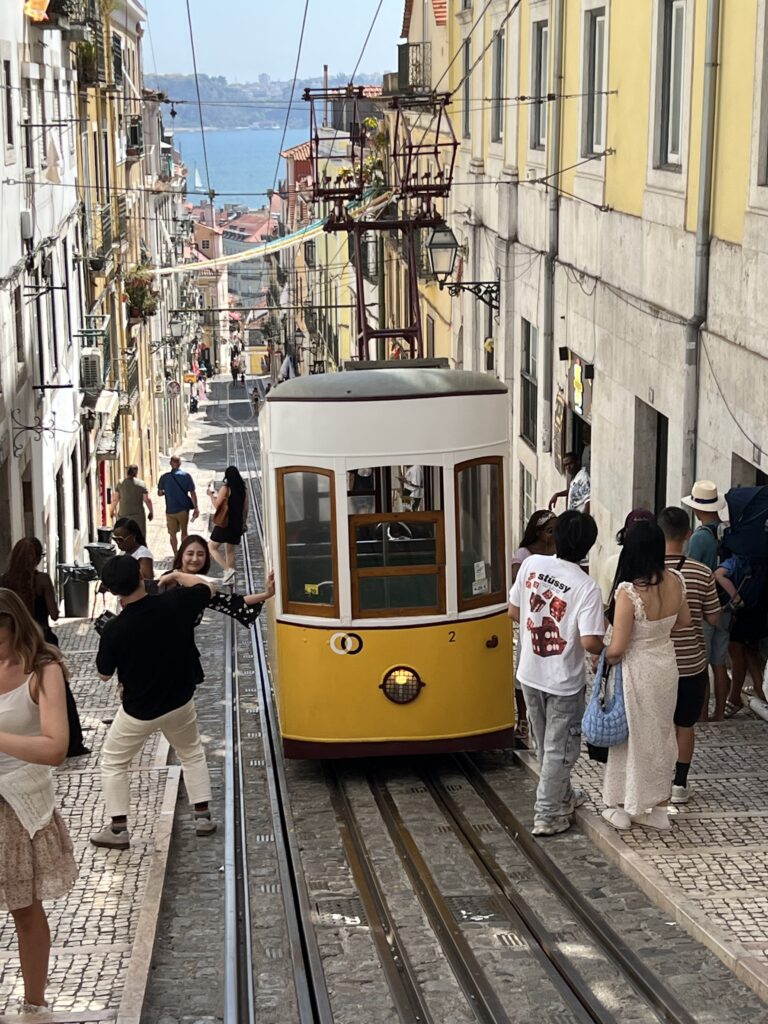
The final stop on my summer trip had a more powerful connection for me. Three years ago, I spent two weeks in Lisbon. Then I spent the last two years writing (and rewriting and rewriting) my first book, where (spoiler alert) a critical part of the action takes place in Lisbon. I had revisited the city in my mind over and over, poring over Google maps and looking at photos to refresh my memory. Being back there now, as that book is out on submission, made me feel like I’d walked into the lives of characters I created. It brought them to life for me and made me feel like I was walking alongside old friends. It reassured me that the fictional world I spun for Mia and Justin is grounded in the real life of Lisbon: colorful, vibrant, quirky, a feast for the senses. I think this might have been my favorite literary visit yet.
“This area of Lisbon—the Alfama, according to Tour Guide Justin—is a different world from where we’re staying. The streets are so narrow and curvy it seems impossible for cars to pass and even less likely they can share the roadway with trams, motorbikes, delivery carts, and pedestrians, but it works. Three- and four-story buildings stand shoulder to shoulder, some painted pink or yellow, many covered in ceramic tiles that shimmer with blue glaze or ornate patterns or polka dots.
I stare out the window with greedy eyes, the visual stimulation setting my senses on fire. I want to sketch everything. I sit on my hands to still my restless fingers.
Our taxi follows a maze of twists and turns, going sideways as much as up. “The Castelo de Sao Jorge sits at the top of this hill,” Justin says. “The streets were laid out like this to deter invaders.” I try not to find Tour Guide Justin adorable, but I fail because he just is.”
— Mia Lieberman describes Lisbon in Mia’s List of Don’ts
Bonus: Best books and movies about San Francisco
When a book or movie about my hometown gets it right, I feel seen. Here are a few of my favorites.
Ali Wong and Randall Park’s Always Be My Maybe stands out not only because it’s a fabulous movie with great acting from Wong and Park, but because it feels like the real San Francisco. The house Park’s character lives in is a typical San Francisco flat. The dive bar his band plays at, the quirky local characters, and the Civic Center Farmer’s Market are all slices of SF life as I know it. Also, it includes a hilarious send-up of pretentious California culture with Keanu Reeves playing himself that is not to be missed.
Some of my favorite romance authors do a great job with local settings, too. Jasmine Guillory’s books are often set in real Bay Area spots with people who feel like they could be my neighbors; I love everything she writes. I’ve just read my first book by Alyssa Jarrett, and Love Apptually is so delightfully Bay Area, the jokes had me laughing from beginning to end. I heard Christina Dudley speak this summer, and she is every bit as funny in person as she is on the pages of Pride and Preston Lin, which also has an authentic Bay Area vibe.
Outside the romance genre, Corey Doctorow’s The Bezzle is not only a beautifully written and compelling book, but the Bay Area settings were delightfully familiar.
Those are at the top of my mind; I’m sure I’m leaving out lots of fantastic books and movies set in the Bay Area.
What’s your favorite depiction of your hometown? What’s your dream literary travel destination?
https://lorelaitarlow.com/wp-content/uploads/2025/08/Lisbon-pavement-scaled.jpeg22582560Lorelai Tarlowhttps://lorelaitarlow.com/wp-content/uploads/2025/07/Lorelai-signature-simple.pngLorelai Tarlow2025-08-20 18:15:452025-10-09 18:12:59A Meditation on Literary Travel
I love romance novels. I love the good ones. I like the so-so ones. I read most of the bad ones to the end because I’m a sucker for a happy ending, even if I grumble the whole way there. But there are a few descriptive tropes that are overused by authors good and bad, and I wish they’d stop. So here’s my little rant. Then back to all positive reviews!
Stop kissing the shell of her ear
I get why you might refer to the shell of an ear, and I also get that some people find having their ears kissed sweet and sensual. But when you refer to “the shell of her ear” (and it’s always a her—male main characters’ ears are uniformly unshell-like, apparently) over and over, I start imaging women with conch shells for ears and then I start counting the number of shells and it ruins the moment for me.
New rule: romance authors can place one kiss on the shell of someone’s ear—maybe a man for a change?—per book. That’s it. If you’ve got a whole beach washed up by the end of your novel, it’s too much.
No, it wasn’t as loud as a gunshot
How do you describe words that drop on a character with life-changing weight? Lots of different ways, and romance authors can get truly creative about this. But one description for an unexpected word or sound that I’m tired of is that it was “as loud as a gunshot.”
First: no, it bloody well wasn’t. Second: as with any overused descriptor, it becomes drained of meaning after a while. So put down your guns, I’m begging you.
Don’t pebble the nipple
A woman’s nipples “pebbling” when she’s aroused is my least favorite overused descriptor. I’ve read books where a character’s nipples pebbled so frequently she could have filled a gravel pit. There are lots of great ways to describe a woman’s nipples responding when she’s turned on. Pebbling is not one of them.
So, now that everyone is on notice, there’s no excuse for any more shells, pebbles, or gunshots. Right? Right? Bueller? Bueller?
https://lorelaitarlow.com/wp-content/uploads/2024/09/508C6E74-A15B-4C0E-8C58-31B0A306140D_1_105_c.jpeg7681024Lorelai Tarlowhttps://lorelaitarlow.com/wp-content/uploads/2025/07/Lorelai-signature-simple.pngLorelai Tarlow2025-06-05 15:38:482025-10-09 18:15:253 Words I’m Begging Romance Authors to Delete
Hi! I’m Lorelai Tarlow, a romance author and avid romance reader. I review romances I like (positive vibes only) to help spread the love. I’m happiest when I can dive deep into an author’s backlist, so my blog is a great place to find great books you might have missed.
My favorite books make me laugh while I swoon, so if you like romantic comedy, you’ve come to the right place. More Bridget Jones’s Diary than 50 Shades of Grey.
If you want the next review in your inbox, sign my email list! I won’t spam you or send you lots of emails (I’m waaay too lazy to write lots of emails).
I’ve created a little rating system to help you find your next favorite read.
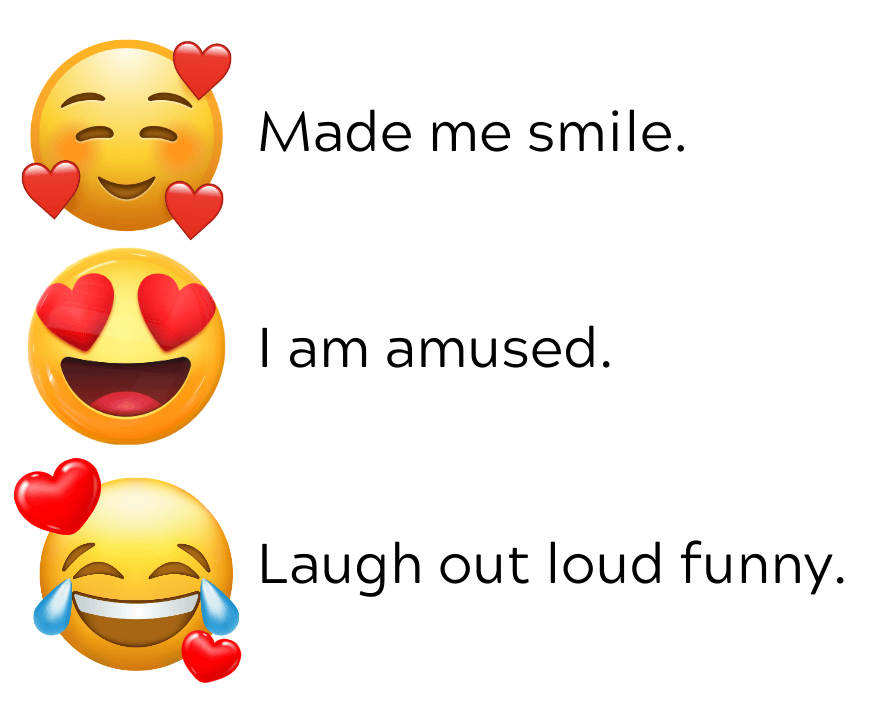
The laughter scale
There are lots of good romances out there, but the ones that make you laugh out loud are the best. Here’s my three-part humor scale.
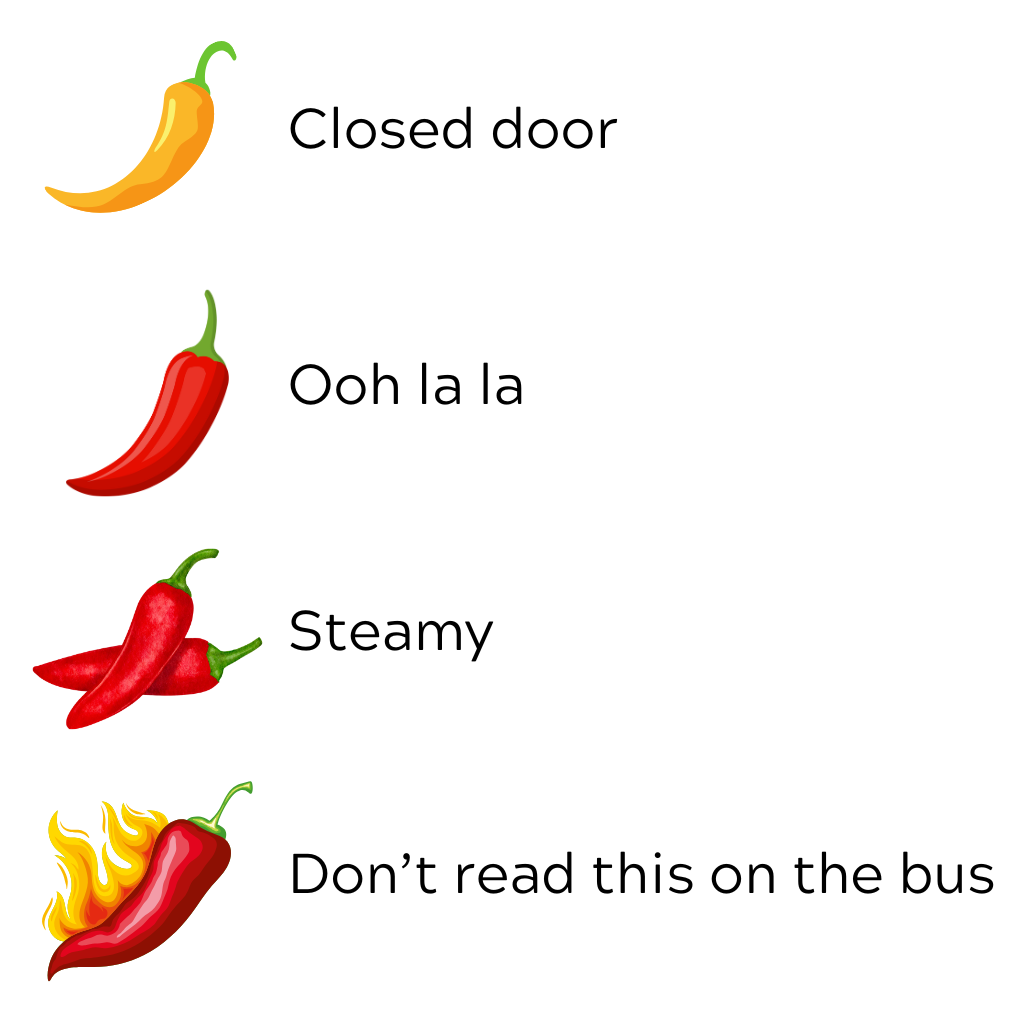
The spiciness score
Okay, let’s come out and say it: this is about how much—if any—sex is in the book. My happy place on this scale is the third level—lots of spice but I’m not exclusive. I hang out with many types of romances, as long as no bodices get ripped. One ripped bodice, and I’m out. Consent, consent, consent!
Tropes and genres
Romances fall into an ever-expanding number of overlapping genres, including:
Romcom
Contemporary
Historical
Queer
Romantasy
Small town
Holiday
Hockey (Why is this such a big category? I don’t know, but I will read every one.)
YA
And so on.
Within each genre, romances fall into tropes or types. Some common tropes:
Enemies to lovers
Second chance
Grumpy/sunshine
Fake dating/marriage
Only one bed/room
Thrown together/reluctant strangers
And so many more.
What I’ll share with you
I’ll let you know the particulars and what I liked about each novel I review. I want to share books I think you might want to read, so it’s positive reviews only. You might love something I don’t like, so I’ll keep it to myself.
And I’ll try to avoid spoilers, although—spoiler alert—every romance has a happily ever after or at least a happy for now. It’s why we love them!
https://lorelaitarlow.com/wp-content/uploads/2024/09/Spiciness-scale.png3451001Lorelai Tarlowhttps://lorelaitarlow.com/wp-content/uploads/2025/07/Lorelai-signature-simple.pngLorelai Tarlow2024-09-19 02:07:562025-10-09 18:16:26How to Rate a Romance Novel